Studies discussed at the Eastern Apiculture Society conference show queen egg size varies and brood pattern alone may not indicate queen quality.
Two findings from honey bee research complicate familiar judgments about queen performance: queens lay larger eggs in queen cells, and a colony’s brood pattern may say less about its queen than beekeepers assume. Both point to the limits of assessing a queen apart from the colony around her.
Those questions came up in conversations at the Eastern Apiculture Society (EAS) Conference, held July 27–29. Theresa J. Martin spoke with Dr. David Tarpy, a leading honey bee researcher, during time outside the conference sessions. Their discussions connected research findings with a practical challenge for beekeepers: deciding what observed signs can actually tell us.
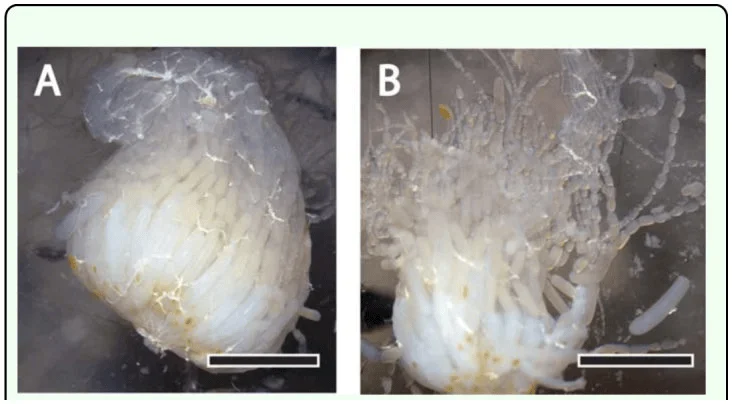
Queens produce different-sized eggs
A 2019 study by Wei and colleagues found that eggs laid in queen cells are significantly larger than those laid in worker cells. Egg size can vary by as much as 50%. That degree of variation raises a striking biological question: how does a queen, whose ovaries contain hundreds of ovarioles, produce an egg suited to queen development?
Researchers propose that she may select which ovariole releases an egg. The mechanism remains a subject for study, but the finding suggests that egg production is more selective than a simple, uniform process. As Martin and Tarpy discussed, the result first prompts surprise, then seems consistent with the queen’s role in producing a successor who will carry forward the colony’s genetics.
For beekeepers, the broader point is that honey bee biology can be more finely tuned than routine observations suggest. The queen’s contribution isn’t limited to the number of eggs she lays; characteristics of those eggs may also vary with their destination.
Brood pattern reflects the colony, too
The second study challenges the use of brood pattern as a stand-alone measure of queen quality. In research conducted by Katie Lee, David Tarpy and colleagues, queens were exchanged between colonies that had good or poor brood patterns. The study assessed 42 colonies: 21 in each category.
After roughly 24 days, the sealed brood pattern of queens moved from poor-pattern colonies improved significantly in colonies with good patterns. That result points to the colony environment as a major influence on brood appearance. Disease, nutrition, pesticide exposure and other colony conditions can affect what a beekeeper sees in the comb, alongside the queen’s egg-laying capacity.
A poor brood pattern therefore isn’t, by itself, reliable evidence that a queen is failing. It may reflect conditions around her, and changing the queen alone may not address the cause. The study doesn’t make brood pattern irrelevant; it makes interpretation more demanding.

Read the signs in context
Together, the studies underscore how easily beekeepers can assign too much credit or blame to the queen. A colony is a complex system, and visible results emerge from interactions among the queen, workers and surrounding conditions. Careful diagnosis means looking beyond a single cue.
Martin left EAS with new questions and renewed appreciation for the research that helps beekeepers interpret their colonies. Tarpy’s work, she says, reflects a sustained commitment to honey bee science and to supporting beekeepers. The practical lesson is to treat brood pattern as one piece of evidence, then consider the colony conditions that may be shaping it.
Theresa J. Martin is the author of Dead Bees Don’t Make Honey: 10 Tips for Healthy Productive Bees, with a foreword by Dr. Thomas Seeley.
REFERENCES
Jackson, J. T., Tarpy, D. R., & Fahrbach, S. E. (2011). Histological estimates of ovariole number in honey bee queens, Apis mellifera, reveal lack of correlation with other queen quality measures. Journal of Insect Science 11(82), 1-11. https://doi.org/10.1673/031.011.8201
Lee, K. V., Goblirsch, M., McDermott, E., Tarpy, D. R., & Spivak, M. (2019). Is the brood pattern within a honey bee colony a reliable indicator of queen quality? Insects, 10(1), 12. https://doi.org/10.3390/insects10010012
Wei, H., He, X. J., Liao, C. H., Wu, X. B., Jiang, W. J., Zhang, B., Zhou, L. B., Zhang, L. Z., Barron, A. B., & Zeng, Z. J. (2019). A maternal effect on queen production in honeybees. Current Biology, 29(13), 2208–2213. https://doi.org/10.1016/j.cub.2019.05.059
Discussion
Sign in to join the discussion.