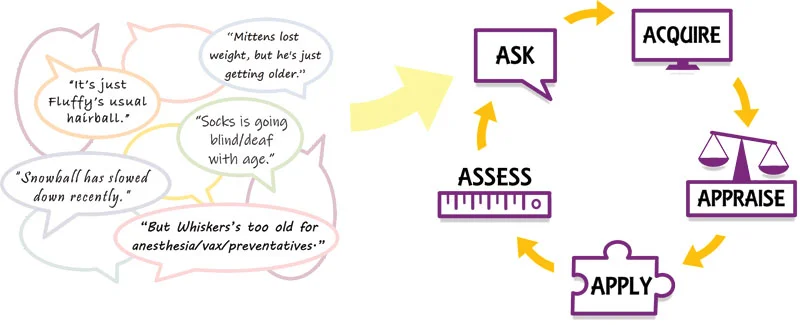
The five A’s help veterinarians turn casual client remarks into focused questions, assess the evidence, guide care, and follow up.
Ask
“It’s just Fluffy’s usual hairball.” Start by finding out what the client means. In evidence searches, a framework such as PICO—patient or population, intervention, comparator, and outcome—helps shape a useful question and identify relevant search terms. Synonyms, Boolean operators such as “AND,” “OR,” and “NOT,” and filters can then sharpen the search.3,4 A casual comment calls for a similar progression: begin broadly, then ask more specific questions. First, establish what the client actually observed. Was it vomiting, regurgitation, coughing up material, diarrhea, or urine? People may not distinguish these events, even when they witnessed them, and their description of what came up may be just as imprecise. One client called it a hairball, then described liquid with no hair. The supposed hairball had no hair at all. Once the event is clearer, ask about duration, frequency, changes over time, and the material produced. Then follow the clues in the case. Did a diet change happen around the time vomiting began? Is part of a damaged plant or toy missing? These questions can seem less productive than an exam or diagnostic test, especially when the schedule is full. But a reliable history helps guide diagnosis; gaps or errors in that history can contribute to medical mistakes.5,6,7Acquire
“Mittens lost weight, but he’s just getting older.” The next task is to locate information that can confirm or challenge the comment. A current weight is an obvious starting point, but a single measurement rarely tells the whole story. First, check with the team: Was the weight taken again today? Were the same type of scale and consistent weighing methods used at each visit? Then review the medical record for a pattern. Weight charts can reveal whether a decline is sustained or whether readings vary with seasons, medication, or illness. Exam notes may add body condition score (BCS), muscle condition score (MCS), and other findings that help distinguish generalized muscle loss associated with aging (primary sarcopenia) from localized muscle loss (atrophy) or the broader loss of fat and muscle seen with disease or malnutrition (cachexia). Older records may sit at another clinic, and a flagged laboratory result may need clarification from the reference lab. As with research access, case information can be hard to obtain when records are incomplete, notes are poor, or the relevant team member or after-hours clinic is unavailable.7,8 The aim is to build a clinical picture from the record as a whole, not to rely on one isolated number.Appraise
“Snowball has slowed down recently.” Collecting information is only useful if we can judge how much to trust it. In research, that means examining study quality, possible bias, and whether the findings apply to the patient and decision at hand (see “Additional resources”).9 A client’s description needs the same scrutiny. The history may come through someone other than the cat’s usual caretaker, or a team member may have summarized it. Details can shift in the retelling, much like a game of telephone.8,10 Even a first-hand account can be vague or inconsistent. “Slowed down” might mean weakness, limping, low energy, or reduced tolerance for exercise. “Recently” could mean days to one client and years to another; “sometimes” and “a small amount” are just as open to interpretation. We should also question our own assumptions. Clients, colleagues, and clinicians can all reach conclusions shaped by expectation or bias.11 Check the timeline and whether the explanation is plausible. The apparent change could be real, an outlier, coincidence, a placebo effect, or still unexplained.| Additional resources The Evidence-Based Veterinary Medicine Association offers the free QUIT Tool, which uses 10 yes-or-no questions to help veterinary professionals flag concerns in treatment studies. RCVS Knowledge has a free EBVM Toolkit and free continuing education EBVM Courses on using the five A’s in everyday practice. For senior cat care, see the 2021 AAHA/AAFP Feline Life Stage Guidelines and the 2021 AAFP Feline Senior Care Guidelines. They cover preventive and advanced care, including how to distinguish age-related changes from health problems. |
Apply
“But Whiskers is too old for anesthesia, vaccines, or preventives.” Before acting, weigh the evidence and its relevance to this patient. That is true when applying research to an individual decision or a clinic guideline (see “Additional resources”). It’s also true when a client assumes age alone rules out a procedure or treatment. Ask what sits behind the concern. Does the client believe vaccines or preventives are inherently riskier for older cats? Are they worried that testing and treatment won’t justify the cost or effort? Perhaps another pet died after a similar procedure. It’s natural to want to agree when a client says they don’t want to put an older cat through something. But age is only one part of the decision. Consider: - The potential benefits and risks of each treatment or procedure, along with alternatives - How each option may affect pain, anxiety, and other patient risks - The cat’s health beyond age, including comorbidities, cooperation, resilience, and quality versus length of life - The client’s finances, time, physical and emotional capacity, values, and priorities A fuller history, verified information, and careful appraisal make it easier to discuss a spectrum of care, sometimes called contextualized care. The goal is to help clients make informed choices in light of the whole case.12,13Assess
“Socks is going blind and deaf with age.” The cycle doesn’t end when a plan is chosen. We need to find out whether it helped. For changes based on research, that can mean a formal audit or an informal reflection by an individual or team.14 The same principle applies to a concern raised by a client. Suppose assessment rules out other medical causes and suggests that Socks has cognitive dysfunction, rather than vision or hearing loss. Dietary and environmental changes may be a reasonable starting point. But without follow-up, there’s no way to tell whether Socks improved. A clinician could use a homemade questionnaire that tracks VISHDAAL signs: vocalization, interaction changes, sleep-wake disruption, house-soiling, disorientation, activity changes, anxiety, and learning or memory problems. That may be useful until a validated questionnaire such as SeniCat becomes available.15 A follow-up call or text can also reveal how things are going. The client’s answers may uncover new questions, sending the case through the five A’s again.
Final thoughts
A client’s offhand remark can contain a question they don’t know to ask. The five A’s give veterinary teams a way to uncover whether it points to a medical problem, a misunderstanding, misinformation from the internet or peers, or a past experience shaping the client’s view. That work depends on patience, empathy, attentive listening, precise and nonjudgmental questions, and clinical reasoning. It’s demanding, especially when a team is tired and the appointment book is full. Still, these understated concerns deserve attention alongside the findings that are easier to see and name.Kyla Savick, DVM, has been interested in animals, science, and logic since childhood. She graduated from Western University of Health Sciences in 2012 and has worked as a small animal relief veterinarian for more than a decade. She joined the Evidence-Based Veterinary Medicine Association (EBVMA) to learn more about the discipline and share what she has learned with readers of Veterinary Practice News.
References
Sources and further reading
The evidence behind this discussion spans clinical decision-making, communication, diagnostic reasoning and quality improvement. These sources offer a starting point for readers who want to examine the research and guidance directly.
- Cockcroft, Peter D., and Mark A. Holmes. (2003) Handbook of evidence-based veterinary medicine. Blackwell Publishing Ltd. https://doi.org/10.1002/9780470690833
- RCVS Knowledge. "Evidence-Based Veterinary Medicine (EBVM): An Introduction." https://www.rcvsknowledge.org/approach/evidence-based-veterinary-medicine/evidence-based-veterinary-medicine-ebvm-an-introduction
- White, Constance, Heather K. Moberly, Erik D. Fausak, Clare Boulton, Julia Shrubb, Laura McGillycuddy, Sally M. Everitt, Sandra D. Nunn, and Marnie Louise Brennan. "Searching for Veterinary Evidence: A Guide for Equine Professionals." Equine Veterinary Education 35, no. 1 (2023): 45–55. https://doi.org/10.1111/eve.13634
- Turner, Stuart. vet. 2016–2018. https://pico.vet
- Arruda Bergamaschi, Natalie, Lukas Huber, Eberhard Ludewig, Alexandra Böhler, Michaela Gumpenberger, Katharina M. Hittmair, Carina Strohmayer, Remco Folkertsma, and Conor Rowan. "Association between Clinical History in the Radiographic Request and Diagnostic Accuracy of Thorax Radiographs in Dogs: A Retrospective Case-Control Study." Journal of Veterinary Internal Medicine 37, no. 6 (2023): 2453–2459. https://doi.org/10.1111/jvim.16899
- Peterson, M. C., J. H. Holbrook, D. Von Hales, N. L. Smith, and L. V. Staker. "Contributions of the History, Physical Examination, and Laboratory Investigation in Making Medical Diagnoses." Western Journal of Medicine 156, no. 2 (1992): 163–65.
- Wallis, Jessica, Daniel Fletcher, Adrienne Bentley, and John Ludders. "Medical Errors Cause Harm in Veterinary Hospitals." Frontiers in Veterinary Science 6 (2019): 12. https://doi.org/10.3389/fvets.2019.00012
- Russell, Elly, Liz Mossop, Ellie Forbes, and Catherine Oxtoby. "Uncovering the 'Messy Details' of Veterinary Communication: An Analysis of Communication Problems in Cases of Alleged Professional Negligence." Veterinary Record 190, no. 3 (2022): e1068. https://doi.org/10.1002/vetr.1068
- Dean, Rachel. "How to Read a Paper and Appraise the Evidence." In Practice 35, no. 5 (2013): 282–85. https://doi.org/10.1136/inp.f1760
- Cordonier, Joseph, Tyler Udenberg, Vincent Defalque, Jay Korbelik, Ljubomir Miljacic, and Nayak Polissar. "Informant Discrepancy between Caretakers in History Reporting in Veterinary Dermatology." The Canadian Veterinary Journal 66, no. 7 (2025): 781–788.
- Canfield, Paul J., Martin L. Whitehead, Robert Johnson, Carolyn R. O'Brien, and Richard Malik. "Case-Based Clinical Reasoning in Feline Medicine: 2: Managing Cognitive Error." Journal of Feline Medicine and Surgery 18, no. 3 (2016): 240–47. https://doi.org/10.1177/1098612X16631233
- Cockcroft, Peter. "Evidence-Based Veterinary Medicine and Contextualised Care." Veterinary Evidence 11, no. 3 (2026). https://doi.org/10.18849/ve.v11i3.754
- Coe, Jason B., Natasha Janke, Carol Gray, and Ruth Serlin. "Clinical Communication Tools for Contextualizing Spectrum of Care." Advances in Small Animal Care 6 (2025). https://doi.org/10.1016/j.yasa.2025.06.013
- Rooke, Freya, John Burford, Sarah Freeman, Tim Mair, Jo Suthers, and Marnie Brennan. "Quality Improvement: Origins, Purpose and the Future for Veterinary Practice." Veterinary Evidence 6, no. 2 (2021). https://doi.org/10.18849/ve.v6i2.358
- Sordo, Lorena, and Danièlle A. Gunn-Moore. "Cognitive Dysfunction in Cats: Update on Neuropathological and Behavioural Changes Plus Clinical Management." Veterinary Record 188, no. 1 (2021): e3. https://doi.org/10.1002/vetr.3
- Gunn-Moore, Danièlle. "Developing and Validating a Diagnostic Tool for Feline Cognitive Dysfunction." Morris Animal Foundation. Funded March 28, 2024. https://www.morrisanimalfoundation.org/study/developing-and-validating-diagnostic-tool-feline-cognitive-dysfunction
Discussion
Sign in to join the discussion.