Microplastics reach bees through air, water, plants and hive materials. Researchers have found them in bees, brood, pollen, honey and wax, while real-world health effects remain unclear.
Microplastics are reaching bees from the air, soil and hive
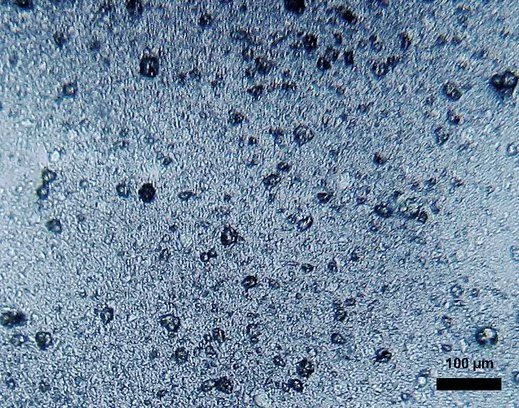
Microplastics have become another pressure on pollinators already contending with habitat changes, intensive farming, climate extremes, disease, parasites and chemical pollution. The concern is more than stray plastic in honey: research reviews report microplastics on and inside adult bees, in brood, pollen and beeswax. How much harm this causes in real-world colonies is still being worked out, but the routes of exposure are widespread.
Click Here if you listened. We’d love to know what you think. There is even a spot for feedback! Read along below!
By: Ross Conrad
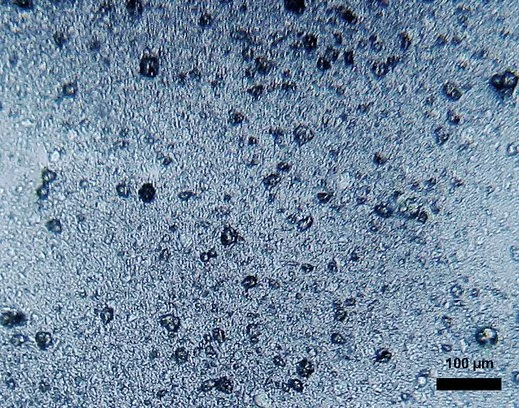
The term covers small plastic fragments and fibers shed as packaging and other products wear down, as well as microbeads made for uses such as cosmetics. Synthetic fabrics—including polyester, nylon, acrylic and spandex (elastane)—also release plastic fibers. The article describes microplastics as 1–5 millimeters across and nanoplastics as smaller than 1 mm. Reviews of recent studies report contamination in bee bodies and hive materials (Gajger et al., 2026; Rodrigues et al., 2025; Gilani et al., 2025).
Exposure follows the bee’s foraging routes
Airborne particles can travel widely, and bees may collect them while foraging, much as they gather tiny pollen grains (Wang et al., 2021; Schiano et al., 2024). Colonies in both cities and rural areas show contamination, though studies report greater pollution around urban apiaries, where plastic waste is often more abundant. In rural settings, agricultural plastic appears to be a major source (Altunışık et al., 2025; Rodrigues et al., 2024).
Bees can also encounter plastic in water, on flower surfaces and in plant tissues exposed to contaminated soil or water. Nectar can carry particles into honey and expose the colony over time; synthetic fibers, rather than fragments, are the form most often reported in contaminated honey. Plastic persists as it breaks into smaller pieces, and ingested fibers can become part of bee tissues. Beeswax appears to accumulate more microplastic than honey, consistent with bees excreting some bodily substances through wax production (Gajger et al., 2026).
There’s another concern: plastic particles can carry metals and chemical pollutants, including PFAS and substances used in plastic manufacturing, which may leach into the environment (Aurisano et al., 2021). Their small size gives them a large surface area relative to their volume, potentially increasing contact with contaminants. Phthalates can also leach from plastic packaging used for honey and other hive products.
Effects on bee health may compound
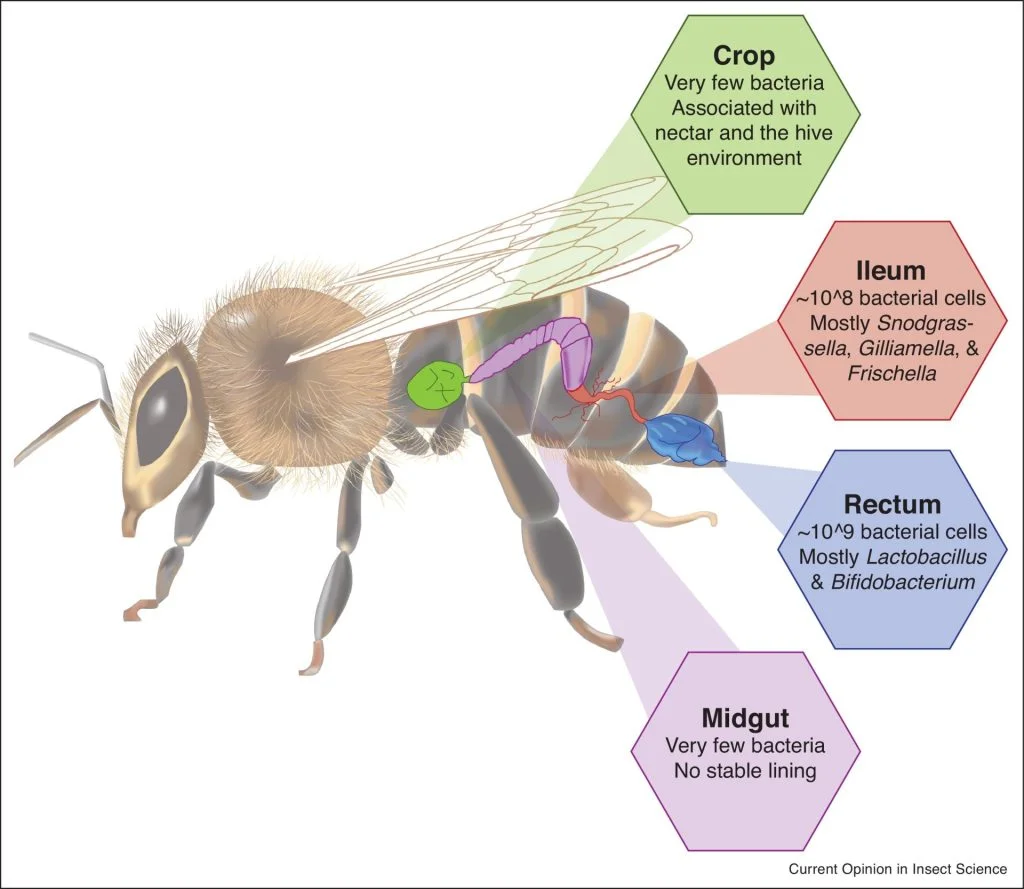
Reported effects include changes in gene expression and lower activity of antioxidant enzymes, which help bees respond to pesticides and other toxic compounds. Studies also link microplastic exposure to disruption of the gut microbiome. That may matter especially after antibiotics used against foulbrood have depleted the colony’s normal microbes: one study found greater sensitivity to microplastics and increased lethal effects in that context (Wang et al., 2021).
Healthy honey bee guts host nine primary bacterial species, mostly in the hindgut and rectum. Five form the core microbiome found in adult worker bees worldwide: Snodgrassella alvi, Gilliamella apicola, two species of Lactobacillus, and a Bifidobacterium. Four others—Bartonella apis, Apibacter adventoris, Frischella perrara and Acetobacteraceae—are not always present (Raymann et al., 2018).
Probiotic supplements may help restore gut microbes disrupted by antibiotics, microplastics or other stressors (An et al., 2025). But the article points to a gap in commercial products: many omit core bee gut bacteria or include microbes not normally found in the honey bee microbiome. Microplastics have also been associated with reduced sucrose response, poorer olfactory learning and impaired memory recall, all of which could hinder foraging. Accumulation in bee brains may affect neural signaling and the central nervous system (Pasquini et al., 2024; Gilani et al., 2025).
Stressors can reinforce one another
A colony’s response may depend on what else it is facing. Microplastics can combine with other plastics, pesticides and pollutants, while nutritional, temperature and pathogen stress can alter the effects; studies describe additive, synergistic or antagonistic outcomes, especially with chronic exposure (Shen et al., 2023; Wu et al., 2026).
That interaction raises concerns for migratory beekeeping. Commercial pollination colonies can face reduced forage diversity, heavy pesticide exposure, more pathogens and the strain of transport. These colonies have been found to live significantly shorter lives than stationary ones (Simone-Finstrom et al., 2016). When foragers die early, younger nurse bees mature faster to replace them, leaving less care for brood and contributing to population decline and weaker overwintering prospects. Microplastic exposure could add to those existing pressures.
Climate conditions may also shape the risk. One study reports lower survival when elevated temperatures coincide with microplastic exposure, while high humidity appears to intensify the survival impact even more than ambient temperature (Tiritelli et al., 2026). The data points to interactions, though it doesn’t fully explain how they play out across different colonies and conditions.
Human exposure and practical choices
The evidence on harm to bees remains incomplete, and the human health picture is also unsettled. A study published in the September–October issue of Neurotoxicology and Teratology examined baby teeth and reported elevated plasticizers and pesticides in 95 percent of the teeth from children with autism (Heilbrun et al., 2026). That result is a reported association; this fragment gives no basis for drawing a causal conclusion.
Ross Conrad says he has previously written about lab-grown meat, precision-fermented vegetable protein and synthetic honey. While preparing this article, he encountered a paper by graduate and undergraduate researchers at Southern Illinois University Carbondale describing 3-D printed, vanilla-scented, protein-rich edible cookies made from recycled plastic bottles and plant waste (Jayasekara et al., 2026). Conrad sees this kind of work as a troubling expression of the idea that people can engineer their way free of the natural world.
For beekeepers, the practical response he proposes is to reduce plastic around colonies and harvested products: choose beeswax foundation, wooden frames and supers, and wood and metal covers and bottom boards; wear cotton bee suits; and store honey in glass jars with metal lids. These steps are intended to limit exposure and help protect colonies, honey and the people who consume it.
References
Altunışık, Abdullah, Damià Barcelò, and Luca Gallitelli (2025). “Pollination under attack: First insights from Türkiye Plain reveal microplastics in bees from both urban and rural areas.” Ecological Indicators 178: 114077. https://doi.org/10.1016/j.ecolind.2025.114077
An, Tong, Wangjiang Feng, Han Li, Yanyan Wu, Pingli Dai, and Yong-Jun Liu (2025). “Combined effects of microplastics and flupyradifurone on gut microbiota and oxidative status of honeybees (Apis mellifera L.).” Environmental Research 270: 121026. https://doi.org/10.1016/j.envres.2025.121026
Aurisano, Nicolò, Roland Weber, and Peter Fantke (2021). “Enabling a circular economy for chemicals in plastics.” Current Opinion in Green and Sustainable Chemistry 31: 100513. https://doi.org/10.1016/j.cogsc.2021.100513
Gilani, Shavali P., M.-h. Moradian, B. Tajdar-oranj, B. Basaran, L. Peivasteh-roudsari, F. Javanmardi, S. M. Khodaei, and A. Mirza Alizadeh (2025). “Microplastics comprehensive review: Impact on honey bee, occurrence in honey and health risk evaluation.” Journal of Applied Ecology 62: 1772–1794. https://doi.org/10.1111/1365-2664.70030
Pasquini, Elisa, Federico Ferrante, Leonardo Passaponti, Francesco Saverio Pavone, Irene Costantini, David Baracchi (2024). “Microplastics reach the brain and interfere with honey bee cognition.” Science of The Total Environment 912: 169362. https://doi.org/10.1016/j.scitotenv.2023.169362.
Gajger, I. T., J. Vlainic, and A. Cvetkovikj (2026). “Disruption of antioxidant defense systems in honey bees and wild bees under environmental xenobiotic pressure.” Antioxidants 15(8): 1016. https://doi.org/10.3390/antiox15081016
Heilbrun, L. P., I. Han, A. Rodriguez, L. A. Shay, D. G. Ruiz de Porras, et al. (2026). “A pilot autism case-control study of pesticides and plasticizers in shed baby teeth.” Neurotoxicology and Teratology 117: 107710. doi: 10.1016/j.ntt.2026.107710. Epub ahead of print. PMID: 42542255.
Jayasekara, S., I. Hou, B. S. K. Jayantha, E. Sheflin, and L. Jayakody (2026). “Engineered yeast consortia for converting plastic and biomass-derived compounds into valuable food additives.” Undergraduate and graduate research in biochemistry and chemical biology, Poster Board #1081, 4532754. https://acs.digitellinc.com/live/37/session/586399
Raymann, K. and N. A. Moran (2018). “The role of the gut microbiome in health and disease of adult honey bee workers.” Current Opinion in Insect Science 26: 97–104. https://doi.org/10.1016/j.cois.2018.02.012
Rodrigues, K. F. S., B. Rani-Borges, R. A. Ando, et al. (2024). “Presence of Microplastics in Workers of Apis mellifera (Linnaeus, 1758) in Different Landscapes in Brazil.” Water Air Soil Pollut 235: 593. https://doi.org/10.1007/s11270-024-07395-9
Rodrigues, K. F. S., B. R. R. Carvalho, F. A. L. Contrera, et al. (2025). “Bees and Microplastic Studies: A Systematic Review.” Neotrop Entomol 54: 56. https://doi.org/10.1007/s13744-025-01268-4
Schiano, Marica Erminia, Luigi Jacopo D’Auria, Roberta D’Auria, Serenella Seccia, Giuseppe Rofrano, Daniel Signorelli, Donato Sansone, Emilio Caprio, Stefania Albrizio, and Mariacristina Cocca (2024). “Microplastic contamination in the agri-food chain: The case of honeybees and beehive products.” Science of The Total Environment 948: 174698. https://doi.org/10.1016/j.scitotenv.2024.174698
Shen, Jie, Boying Liang, and Hui Jin (2023). “The impact of microplastics on insect physiology and the indication of hormesis.” TrAC Trends in Analytical Chemistry 165: 117130. https://doi.org/10.1016/j.trac.2023.117130
Simone-Finstrom, M.; Li-Byarlay, H.; Huang, M. H.; Strand, M. K.; Rueppell, O.; and Tarpy, D. R. (2016). “Migratory Management and Environmental Conditions Affect Lifespan and Oxidative Stress in Honey Bees.” Sci. Rep. 6: 32023.
Tiritelli, R., Alexandra Dal Lago, Rosa Ranalli, and Giovanni Cilia (2026). “The humidity is what really gets bees: The impact of thermal stress and microplastics ingestion on the survival of Apis mellifera ligustica (Spinola, 1806).” Environmental Toxicology and Pharmacology 124: 105046. https://doi.org/10.1016/j.etap.2026.105046
Wang, Y., J. Huang, F. Zhu, et al. (2021). “Airborne Microplastics: A Review on the Occurrence, Migration and Risks to Humans.” Bull Environ Contam Toxicol 107: 657–664. https://doi.org/10.1007/s00128-021-03180-0
Wang, Kai, Jiahuan Li, Liuwei Zhao, Xiyan Mu, Chen Wang, Miao Wang, Xiaofeng Xue, Suzhen Qi, and Liming Wu (2021). “Gut microbiota protects honey bees (Apis mellifera L.) against polystyrene microplastics exposure risks.” Journal of Hazardous Materials 402: 123828. https://doi.org/10.1016/j.jhazmat.2020.123828
Wu, Yiqing, Lina Qin, Yimeng Zhang, Yifan Jia, Yaoyang Lü, Nianlong Wang, Hao Zheng, Liang Li, and Zijing Zhang (2026). “Co-exposure to polystyrene microplastics and glyphosate induces gut microbiota dysbiosis and cognitive impairment in honeybees.” Journal of Hazardous Materials 507: 141796. https://doi.org/10.1016/j.jhazmat.2026.141796
Discussion
Sign in to join the discussion.