Moving payment and scheduling into exam rooms can ease front-desk congestion, improve client conversations and help veterinary teams capture charges.
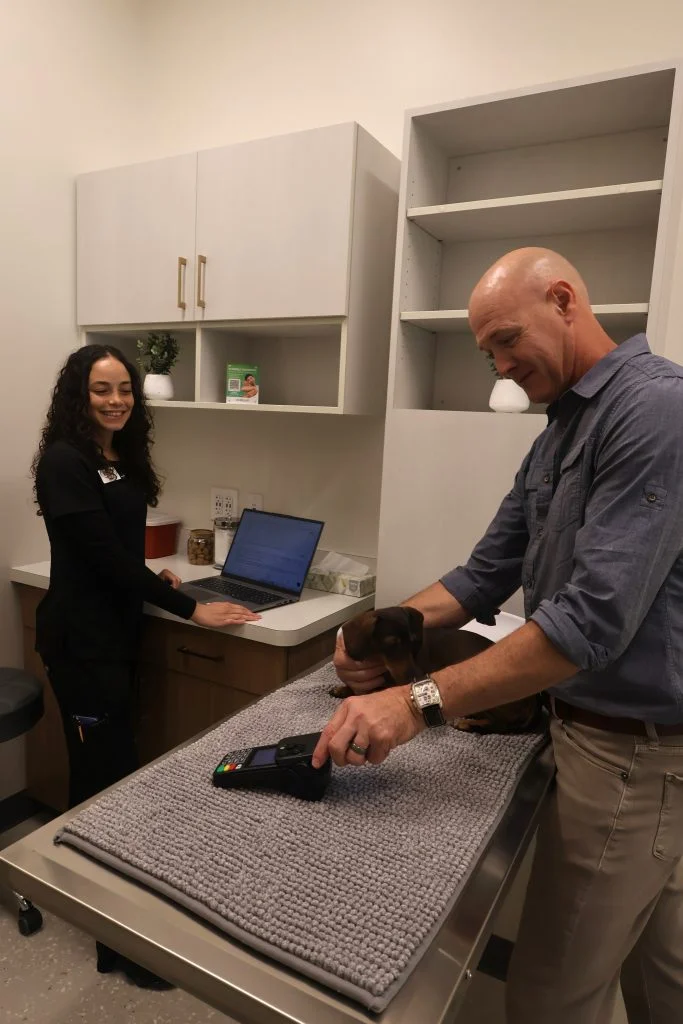
Moving checkout into the exam room can change more than where a client pays. It gives veterinary teams a chance to discuss costs, confirm charges and book follow-up care while the visit is still fresh, while freeing reception staff to greet clients and answer calls. For practices managing busy appointment blocks, that shift can also reduce the queue at the front desk.
At Partners Animal Hospital in Lakewood Ranch, Florida, veterinarians Reagan McDonald, DVM, and practice manager Jennifer Atchley built the workflow into the hospital from its June 2026 opening. Before settling on the approach, they visited two other Partners Animal Hospitals, in Wesley Chapel and Sarasota, to observe how it worked. Laptops and mobile card readers let staff finish records and take payment in the exam room, with transactions posting to the practice information management software, or PIMS.
Atchley says the aim is to keep client service representatives available for the work clients need at the front desk. “I want our client service representatives (CSRs) to be present on the phones and greeting clients,” she says. “No one wants to wait to be helped.” The cited average checkout takes seven to 10 minutes at the front desk, compared with two to five minutes in the exam room.
Put the clinical conversation before the payment
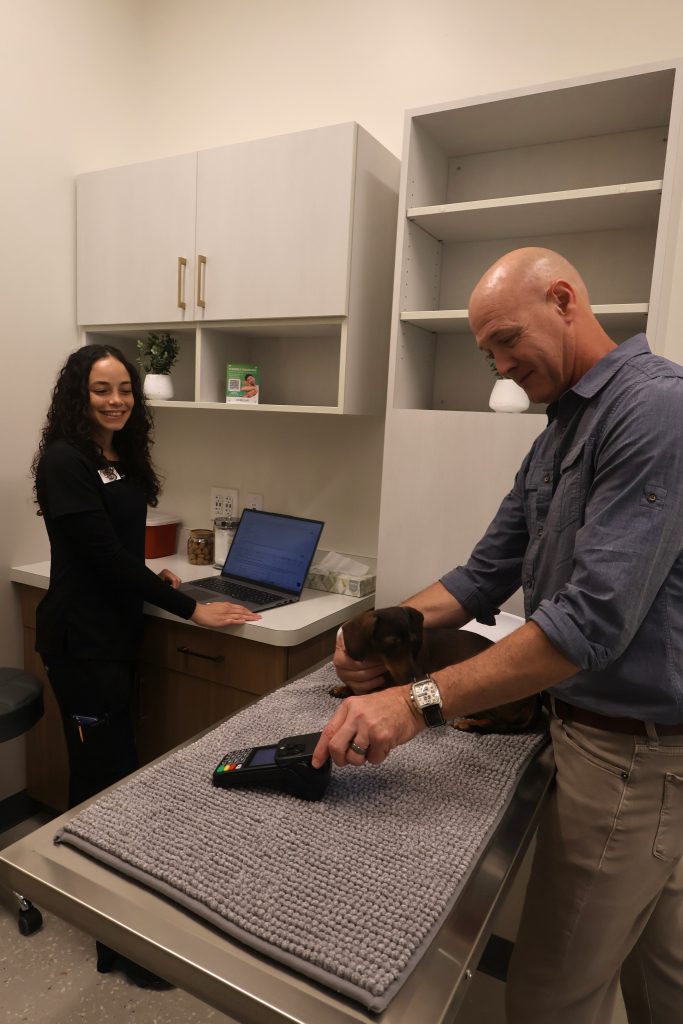
When teams handle checkout in the exam room, they can present the invoice alongside the care plan and explain what each service covers. That gives clients a private setting to ask questions about fees, rather than encountering costs for the first time at a busy counter. If a client can’t afford the recommended plan, staff can discuss financing or offer alternative treatment paths through a spectrum-of-care approach.
That exchange can also clarify who to contact afterward. Technicians who have built rapport during the appointment can answer immediate questions and provide a familiar point of follow-up, Atchley says. The payment moment becomes part of the care conversation, rather than a separate handoff to administrative staff.
The room itself may make the visit easier for clients with mobility challenges, children, tight schedules or anxious pets. Animals can avoid a crowded lobby and contact with other pets, and clients can head to their cars once the appointment is complete. Mobile terminals also support smartphone payments, according to the practice’s workflow.
Relieve the front desk during appointment peaks
The operational case is clearest when several appointments end at once. The source cites an average of 15 patients per veterinarian per day. In a three-doctor practice, that amounts to 45 potential checkouts handled in exam rooms rather than routed through reception. If three clients with 10 a.m. appointments finish together, front-desk checkout can create a queue; in-room transactions let staff complete those payments in parallel.
That capacity matters because CSRs can continue answering calls and welcoming arriving clients instead of pausing those duties to process departures. The medical team also remains available for last-minute questions. In-room checkout works best when the clinic has enough mobile equipment and a clear division of responsibilities, so the faster client flow doesn’t simply become an unplanned administrative burden for technicians.
Use the visit to book the next one
Forward booking is another potential gain. The article points to dental practices, where hygienists have had greater success scheduling patients’ next visits than checkout coordinators. In veterinary care, the technician or clinician who knows the recommended timing can make the next appointment part of the care plan. Atchley describes that as a clinical recommendation rather than a task added at the counter, where clients may already be focused on leaving.
That distinction is practical: the person discussing the animal’s follow-up needs can connect the timing to the care delivered. Clients can then leave with the next step already scheduled, rather than relying on a later reminder to make an appointment.
Connect billing to the medical record
Capturing every service on the invoice is a separate but related benefit. The source cites estimates that veterinary practices miss five to 10 percent of annual revenue through missed charges and incomplete invoices. At a practice with $2 million in annual revenue, that range would represent $100,000 to $200,000. Examples include fecal tests, diagnostic work, injection fees and progress exams. If a service is omitted from billing, its future reminder may also be missed.
Technicians who were present for care can enter the relevant charges and review them with the client. The article also notes that AI scribe technology may help identify billing gaps. A brief reconciliation against the medical record offers another check:
- Open the visit’s medical record, or SOAP note.
- Open the invoice beside it.
- Review the Assessment and Plan.
- Confirm that each treatment, service and product appears on the invoice.
This 60-second review ties the bill to the documented care and gives the team a consistent point of reference before collecting payment.
Equip the team before changing the workflow
Implementation starts with the PIMS and the rooms themselves. Practices should confirm with their software provider that mobile payment terminals can post transactions to the system; many PIMS providers offer integrated payment options. They’ll also need laptops for the clinicians working in exam rooms. A practice with three doctors seeing outpatient appointments, for example, needs three laptops to support the workflow.
Test Wi-Fi in every exam room before relying on mobile transactions. A dead spot can delay payment and frustrate both clients and staff; network extenders may help address coverage gaps. Digital receipts, discharge instructions and treatment plans can reduce printing delays. Teams can also bring medications from the pharmacy into the room along with the laptop and card reader, completing the handoff in one trip.
Set expectations with clients in plain language. A suggested script is: “To make checkout easier and faster for you, we’ll do it in the exam room today so you can go directly to your car when we’re finished. You won’t need to stop at the front desk.”
Technicians may need time and training to take on payment and scheduling conversations. Practices can explain the purpose of the change, help staff present invoices and discuss third-party payment options, then introduce the workflow gradually. The article suggests starting with euthanasia and discharge appointments before expanding to other visit types as technicians gain experience.
There’s one practical exception at Partners Animal Hospital: clients paying cash still check out at reception because the hospital uses a single cash drawer. The broader lesson is that in-room checkout depends on fitting payment tools, staffing and client communication to the clinic’s actual operations. When those pieces line up, checkout can finish the visit while the clinical team and client are still together.
Wendy S. Myers, CVJ, trains veterinary teams to communicate with clarity and confidence, inspiring client trust and better medical care. Founder of Communication Solutions for Veterinarians, she teaches proven skills through online courses, conferences, and consulting. Myers' experience as a partner in a specialty and emergency hospital gives her insight into practice challenges. Explore her online training at CsvetsCourses.com.
References
- Larkin M. Benchmarking Data Plus Elevating Efficiency Equals Practice Productivity. AVMA News. Accessed September 24, 2026. https://www.avma.org/news/benchmarking-data-plus-elevating-efficiency-equals-practice-productivity
- Faustino A. How to Improve Dental Recall with These Tips. Accessed September 22, 2026. https://capforge.com/how-to-improve-dental-recall-with-these-tips/
- Galvin J. Maybe Money Does Grow on Trees. AAHA Trends. Accessed September 24, 2026. https://www.aaha.org/newstat/publications/maybe-money-does-grow-on-trees/
- Jenkins T. How to Prevent Missed Billing: The Hidden Financial Toll of Missed Charges in Veterinary Clinics. PetsApp. Accessed September 24, 2026. https://petsapp.com/blog/how-to-prevent-missed-billing-the-hidden-financial-toll-of-missed-charges-in
- Brittany N. A Quick Check That Catches Missed Charges Before Checkout. Shepherd. Accessed September 24, 2026. https://www.shepherd.vet/blog/a-quick-check-that-catches-missed-charges-before-checkout/
Discussion
Sign in to join the discussion.