Even modest weight loss can improve dogs’ mobility and health. Personalized feeding plans and regular follow-ups help turn early progress into lasting change.
For dogs carrying excess weight, waiting for an ideal body condition before recognizing success misses a useful clinical opportunity. Research links even partial weight loss with improvements in mobility, activity, quality of life, cholesterol and cardiac measurements. That gives veterinary teams a practical way to make a long-term program feel achievable: set manageable goals, track early changes and show clients what those changes mean for their dog.
Canine obesity affects more than half of adult dogs in the United States, yet conversations about weight and sustained treatment remain difficult. Reaching a target weight can take months or more than a year, and many programs lose participants along the way. One report found that 28% of owners said their dog had reached a healthy weight; in a referral specialty clinic, 61% completed the weight-loss program. The figures point to a familiar challenge: the plan must work for the household as well as the patient.
Progress has clinical value before the goal weight
A reduction of 5% to 10% from a dog’s starting weight can provide meaningful benefits even when the dog has not reached an ideal body condition score (BCS). In dogs with osteoarthritis, lameness may decline after about 6% weight loss. Activity has been shown to increase from around 3.2% loss, while quality-of-life scores can improve from about 5.7%. A roughly 6% reduction has also been associated with better cholesterol, and cardiac measurements have changed after approximately 4.7% loss.
Those early gains matter in practice. Weight management is a sustained effort, and visible progress can help clients stay engaged. Veterinary teams can make that progress easier to recognize by setting specific targets, reviewing weight regularly and asking about changes in movement, energy and comfort. A missed ideal-weight target does not erase improvement already achieved.
Maintaining a lean body condition is associated with broader health benefits. In one study, dogs kept at an ideal BCS of 4 out of 9 had a median lifespan 1.8 years longer. Research also links leanness with delayed osteoarthritis onset and a later need for long-term treatment in Labradors, less age-related loss of lean mass, improved blood lipid profiles, and reduced inflammation and oxidative stress after weight loss. Respiratory function and oxygenation during deep sedation may improve as well. Studies have also reported changes in cardiac measurements and obesity-associated kidney biomarkers after weight loss.
These findings offer clinicians a range of outcomes to discuss, rather than making the conversation hinge on a number on the scale. For a dog with joint pain, improved mobility may be the most tangible early result. For another patient, the relevant milestone may be greater activity or a better quality of life. The clinical aim is to connect the plan to benefits the client can observe.
Earlier treatment gives the plan more room to work
Starting while a dog is mildly overweight is associated with better weight-loss outcomes than waiting until excess fat has accumulated. As obesity becomes more pronounced, programs tend to take longer, weight loss can slow, lean muscle loss may increase, and the chance of reaching the target can fall.
Age and other health conditions can narrow the available options. For example, chronic kidney disease may require protein restriction, which can complicate use of standard weight-loss diets that are higher in protein. Even then, partial weight loss may help, including for dogs with osteoarthritis. The nutrition plan needs to account for the whole patient, not simply the desired calorie reduction.
Choose a diet for nutrient delivery, not just fewer calories
Weight loss requires a calorie deficit, but restricting calories also restricts nutrients. A suitable diet should provide enough essential nutrients while supplying fewer calories, and it should support satiety and preservation of lean muscle. Common nutritional priorities include adequate protein and increased fiber, particularly insoluble fiber, which can help dogs feel full.
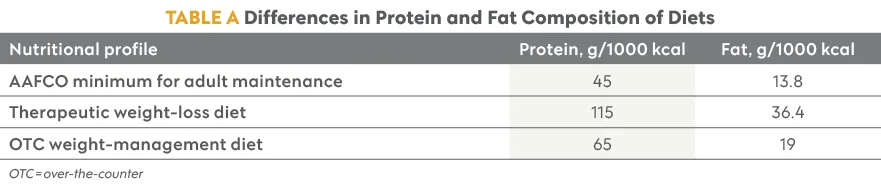
That’s where diet choice matters. Products labeled “light,” “lite” or “low-calorie” are subject to calorie-related standards, while claims such as “healthy weight” or “weight management” are not regulated in the same way. Neither label alone tells a clinician whether the food will meet nutrient needs when fed in a restricted amount. Therapeutic weight-loss diets are formulated and fortified for calorie restriction; restricting an over-the-counter food can raise the risk of nutrient deficiencies.
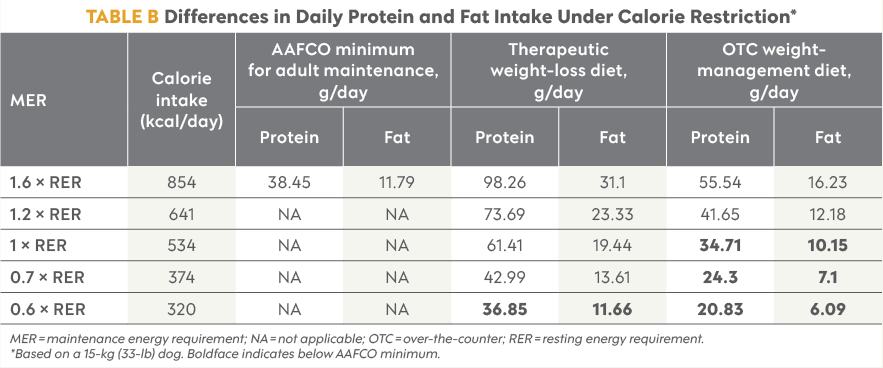
A case example illustrates the issue: a 5-year-old Labradoodle with a BCS of 8 out of 9 and an estimated ideal weight of 15 kg (33 lb) could receive different amounts of protein and fat from a therapeutic weight-loss diet and an over-the-counter weight-management food at the same calorie level. Both foods in the example meet AAFCO nutrient profiles for adult maintenance, but dogs need more than 30 essential nutrients. The team should consider nutrient intake across the full ration, especially when the calorie allowance is low.
Calorie needs vary by dog, depending on factors such as activity and metabolism. Calculations in this approach use estimated ideal body weight. A common starting allocation is one times resting energy requirement (RER), calculated as RER = body weight in kilograms0.75 × 70. Some mildly overweight dogs may succeed at 1.2 to 1.4 times RER, while some obese dogs, including those with a history of regaining weight, may need 0.9 times RER or less. These are starting points, not fixed prescriptions. Many overweight dogs need less energy than standard adult maintenance feeding assumptions provide.
Build a feeding plan around the dog and household
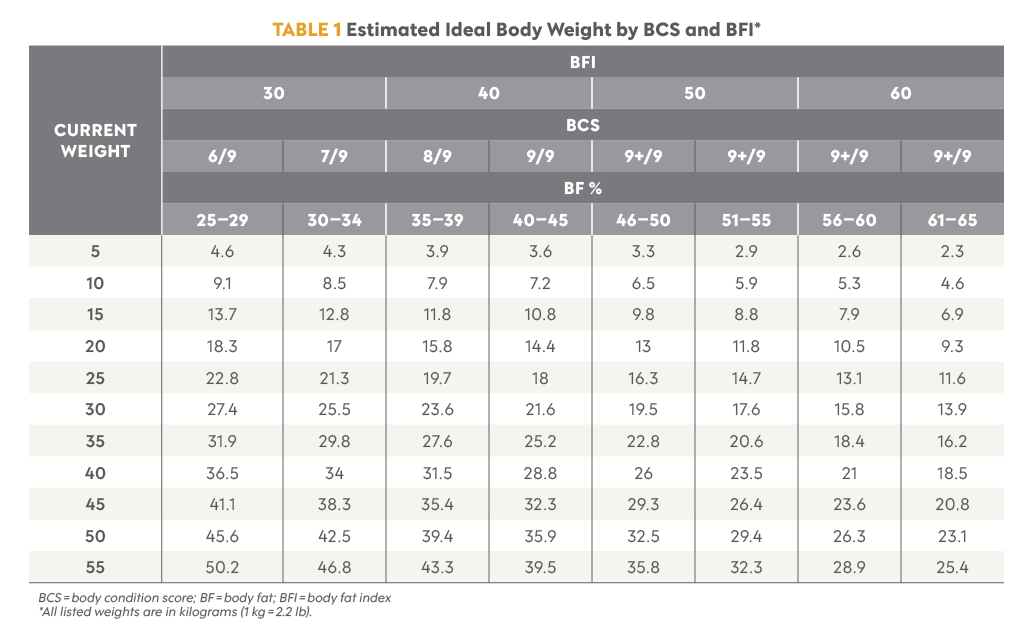
A useful plan starts with an estimate of ideal body weight. DEXA can provide an estimate, but BCS and body fat index are more accessible tools in everyday practice. Once ideal weight is estimated, the team can calculate RER and record the dog’s current daily intake.
That intake assessment should include every source of calories: the main food, toppers, treats, table food and supplements. Comparing the total with RER helps establish an initial allowance. Treats deserve particular attention because they often carry social and training value for the household. They can remain part of the plan, provided they fit within it.
To help preserve the balance of a complete diet, treats should account for no more than 10% of the maintenance energy requirement, with at least 90% coming from a complete and balanced food. Low-calorie treats can help. For households that reward frequently, portions of the dog’s daily food can serve as training rewards; canned food can also go into enrichment toys or be frozen for treats.
Follow-up is part of the treatment, not an administrative extra. A typical target is a loss of 1% to 2% of body weight per week. If progress falls outside that range, the calorie allowance can be adjusted by 10%. Regular check-ins give the team a chance to assess weight, troubleshoot feeding routines and reinforce gains. Once the dog reaches its target weight—or achieves a clinically meaningful improvement—the team can raise calories gradually, often in increments of 5% to 10%, while monitoring for weight regain.
Weight management works best as a series of decisions informed by the individual dog’s response. An estimated ideal weight helps set direction, while measured progress guides adjustments. The practical takeaway for veterinary teams is to begin early, tailor food and calorie targets to the patient, account for treats, and make small improvements visible. Those steps can turn a demanding program into one clients can sustain—and give dogs measurable health benefits before they reach the final target.
Reported benefits of maintaining a lean body condition or losing weight include longer median lifespan, delayed osteoarthritis and age-related loss of lean mass, improved lameness and quality of life, and changes in blood lipids, inflammation, oxidative stress, respiratory function, cardiac measurements and obesity-associated kidney biomarkers.
Partial weight loss has also been associated with specific improvements: reduced lameness at about 6% loss, increased activity from around 3.2%, improved quality of life from around 5.7%, improved cholesterol at approximately 6%, and changes in left ventricular diameter after about 4.7% loss.
The post Canine Weight Loss: Why Small Gains Matter for Long-Term Health appeared first on Today's Veterinary Practice.
===
Discussion
Sign in to join the discussion.