A two-year, 900-colony study found stronger spring colonies and higher modeled revenue with a complete pollen-replacing feed.
Fall and winter nutrition may shape a commercial honey bee operation’s results well beyond the cold season. In a two-year field study spanning more than 900 colonies, bees fed a nutritionally complete pollen-replacing feed entered almond pollination stronger, survived at higher rates through March, and built up faster in spring than colonies given commercial supplements. The findings point to winter feeding as a management decision with effects across pollination, colony replacement and honey production.
The study, published in Insects by Kulhanek and colleagues in 2026, compared APIX Pollen, identified in the paper as Pollen-Replacing Feed 1 (PRF-1), with the commercial protein supplements already used by participating beekeepers. The article’s authors, Anne Marie Fauvel of Honey Bee Vitality, LLC, and Dr. Brandon Hopkins of Washington State University, are also co-authors of the study. That connection is relevant context when weighing the findings and the economic projections.
Colony strength diverged before almond pollination
Five commercial beekeeping operations in California and Idaho took part. Each managed more than 2,000 colonies and continued its usual management and feeding practices during the trial. Within each operation, colonies were assigned to PRF-1 or the beekeeper’s selected commercial supplement. Colony condition was assessed in fall, January and March, with data collected by a third party.
The groups began the trial at comparable sizes. By January, however, PRF-1 colonies averaged 1.19 more frames of bees, a 16% advantage over colonies fed commercial supplements. The difference also showed up in the share of colonies meeting an eight-frame threshold used for premium almond pollination contracts: 67.9% of PRF-1 colonies qualified, compared with 57.2% of the comparison group. That gap of 10.7 percentage points was statistically significant.
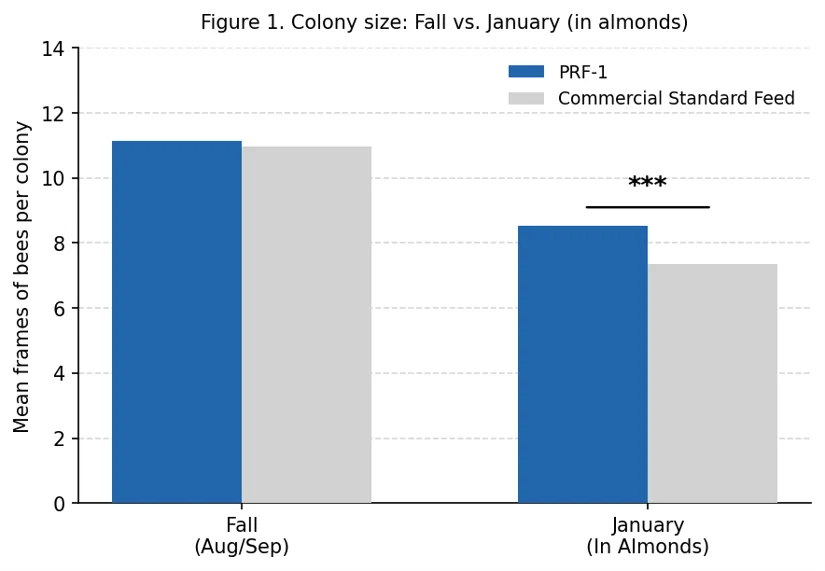
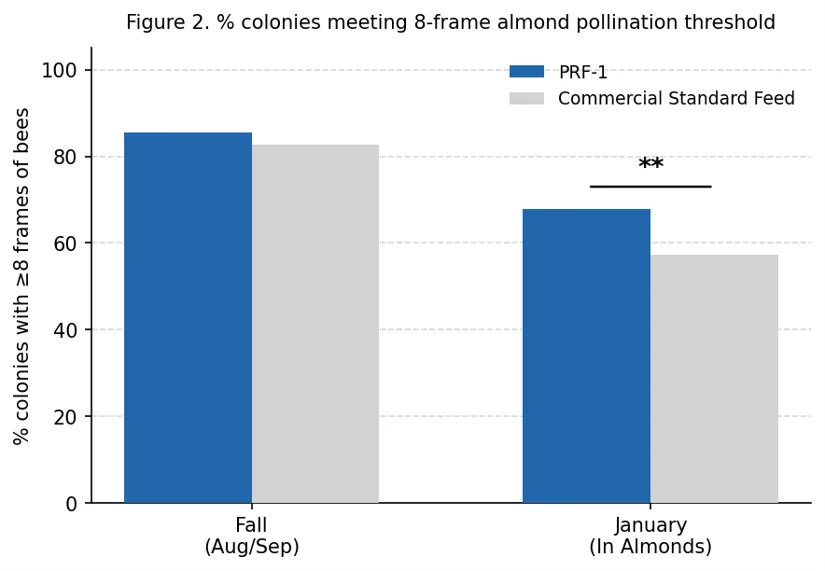
For beekeepers paid according to colony strength, the January results have a direct operational bearing: more colonies reached the premium contract threshold. The study doesn’t establish that every operation will see the same financial outcome, but the field design offers a useful test of the feed under routine commercial conditions rather than a controlled laboratory setting.
The gap remained after almond bloom
Almond bloom provides abundant, high-quality pollen, so it could have narrowed differences created by fall and winter diets. The March assessments suggest it did not. After bloom, PRF-1 colonies averaged 2.57 additional frames of bees, equivalent to a 36% population advantage, and 0.79 more frames of brood, a 40% increase over the comparison colonies.
The researchers also examined whether stronger colonies in March simply reflected a larger starting population. For one subset, they equalized colony sizes in January and tracked growth through March. PRF-1 colonies added 1.22 more frames of bees during that period. The result supports the interpretation that winter nutrition affected spring growth, even when initial colony size was held equal.
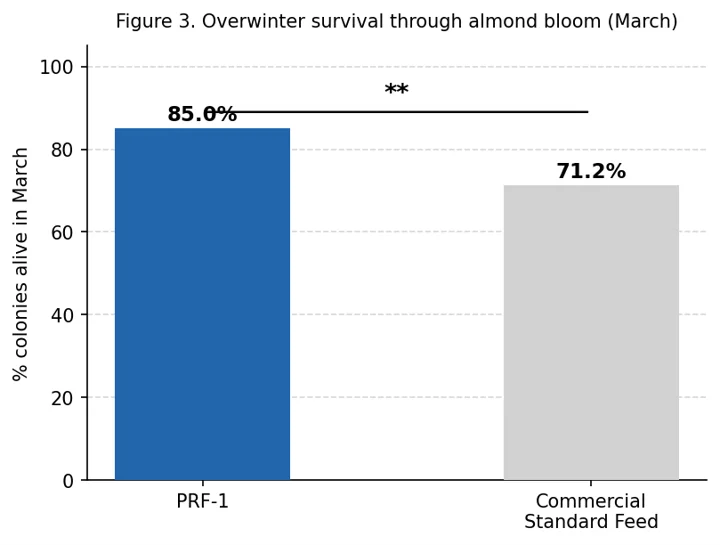
Survival also favored PRF-1: 85.0% of those colonies remained through March, compared with 71.2% of colonies on commercial supplements, a 13.8 percentage-point difference. The researchers reported no difference between feeding groups in Varroa loads or pathogen prevalence, lending support to nutrition as the factor associated with the observed performance differences.
Revenue estimates depend on a modeled operation
The paper’s economic analysis translates those biological outcomes into a hypothetical 100-colony business. It used 2024 prices of $181 per hive for almond pollination, $58.10 for apple pollination and an average of $1,439 per hive for honey production. Under those assumptions, the PRF-1 group generated $1,931 more from almond pollination in the first year.
Its larger spring population also supported a higher projected number of five-frame nucleus colonies, or splits: 194, compared with 143 for the commercial-supplement group. Combining almond and apple pollination with honey, the model estimated $12,066 more in first-year gross revenue per 100 colonies, or $120.66 per colony. These are modeled gross revenues, not a guaranteed return; the supplied analysis does not account here for feed costs or establish that every operation’s prices and production will match the assumptions.
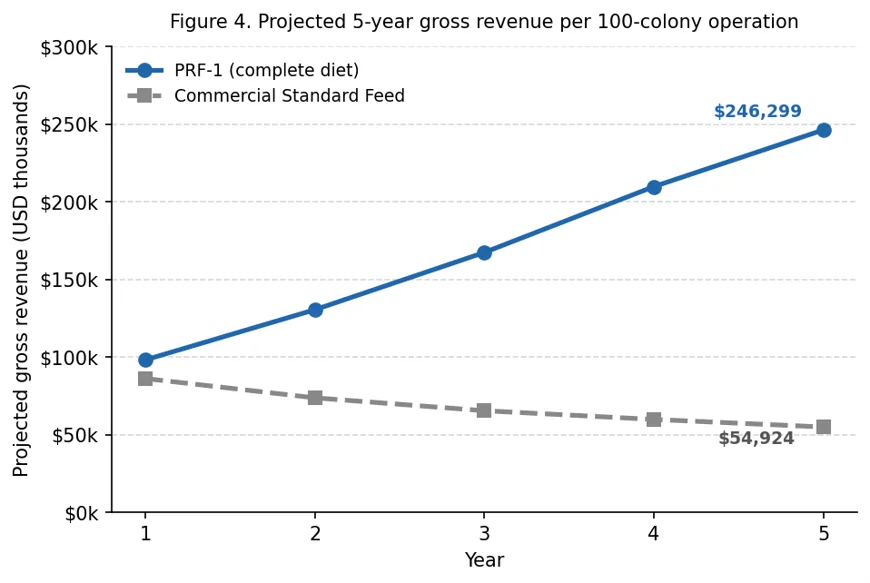
The five-year projection widens the difference, reaching $246,299 for the PRF-1 operation versus $54,924 for the commercial-standard operation in Year 5. That result reflects the model’s compounding assumptions about survival, colony growth and production. It should be read as a scenario built from the study’s outcomes and specified prices, rather than as a forecast for any particular beekeeper.
What the trial adds to feeding decisions
Fall and winter are the periods when colonies raise long-lived winter bees, whose condition influences survival and spring buildup. The study’s authors argue that many existing pollen substitutes lack nutrients such as essential amino acids and sterols. Their trial adds commercial-scale evidence to an earlier study on complete pollen-replacing diets, published by Bogaert and colleagues in 2025.
Results were reported across five operations in two states, despite differences in location and management. The scale and duration make the findings more relevant to commercial practice than a short, small-group feeding test, while the economic case still depends on local costs, contracts and colony outcomes. For operators preparing bees for almond pollination, the practical question is whether a more complete feed’s purchase price is justified by improvements in survival, contract eligibility and later production.
The 2026 study is available open access at https://doi.org/10.3390/insects17030243. The earlier paper is available at https://pmc.ncbi.nlm.nih.gov/articles/PMC12000826/.
References
Bogaert, T., Reams, T., Maillet, I., Kulhanek, K., Duyck, M., Eertmans, F., Fauvel A.M., Hopkins B. & Bogaert, J. (2025). “A nutritionally complete pollen-replacing diet protects honeybee colonies during stressful commercial pollination — requirement for isofucosterol.” Proceedings of the Royal Society B: Biological Sciences, 292(2045), 20243078. https://pmc.ncbi.nlm.nih.gov/articles/PMC12000826/
Kulhanek, K., Bogaert, J., Fauvel, A. M., Hopkins, B., & Bogaert, T. (2026). “Enhanced Honey Bee Colony Strength and Economic Returns from Fall and Winter Feeding with a Complete Pollen-Replacing Feed.” Insects, 17(3), 243.
Discussion
Sign in to join the discussion.