From a tamandua to a Komodo dragon, zoo rehabilitation adapts familiar veterinary techniques to each animal’s needs and builds on close keeper relationships.
Zoo rehabilitation is built on a practical idea: many treatments used for dogs and cats can also help wildlife, provided clinicians adapt them to each animal’s body and temperament. At the San Diego Zoo, a seven-month therapy plan helped Mani, a five-year-old tamandua, move more comfortably after spinal disease left him stiff, slow and prone to falls.
Turning a diagnosis into movement
Mani had trouble climbing, pulling himself up while hanging by his tail and descending a sloped perch. Keepers also saw him fall. A CT scan found caudal lumbar spondylosis deformans, along with spondylosis in his cervical and thoracic spine. In a mobility assessment, senior veterinarian Deena Brenner observed stiffness in his rear legs and hips, reduced hip extension, mild kyphosis at the thoracolumbar junction and deliberate tail use.
The rehabilitation plan focused on strength, function and mobility through tasks Mani could perform in a controlled setting. He walked between vertical poles in a “vertical weave,” stepped over raised Cavalletti rails, and moved through a tunnel designed to encourage spinal extension. A balance board and incline ramp added further challenges.
After seven months, wildlife care staff reported that Mani was moving more comfortably, holding a stronger posture in his rear limbs and no longer slipping or falling. The case illustrates how therapy can be shaped around an animal’s everyday movements. For Mani, climbing and navigating obstacles became part of the treatment plan.
Familiar problems, species-specific care
James Steeil, a supervisory veterinarian at the Smithsonian’s National Zoo and Conservation Biology Institute, sees a close connection between zoo medicine and general practice. “I can have the same conversation about the treatment of arthritis in my cat and in a tiger at the zoo,” he says. Diagnostics, treatments and specialist collaboration often look similar, while safety requirements can shape what outcomes and procedures are possible.
That common ground is especially apparent in age-related joint disease. Zoo animals often live longer in managed care than they would in the wild, and osteoarthritis is the most frequent reason they’re referred for rehabilitation, according to Brenner. Arthritis can affect the spine, hips, stifles and elbows, much as it does in dogs and cats. Therapy also supports recovery after injuries and surgery.
The techniques travel across species, but the details have to fit the patient. Brenner says canine rehabilitation methods can often be adapted for other zoological species. The shared tools include analgesics, exercise and range-of-motion work; the challenge is matching each activity to a different body, movement pattern and tolerance.
Veterinary teams also rely on measurements to guide care. Physical exams, radiographs and CT scans help establish baselines and support diagnosis. Goniometry and muscle-girth measurements can document mobility and strength over time, giving clinicians a way to assess whether a treatment plan is helping.
Keepers make participation possible
Rehabilitation depends on the people who know the animals best. Zoo veterinarians work with animal care specialists, who observe their patients every day and may spot changes in gait, posture or behavior before those changes become obvious in a brief clinical examination.
At Brookfield Zoo Chicago, Jennifer McGee, director of Wildlife Experiences, describes the keepers’ relationships with animals as long-term and respectful. Their role extends beyond noticing a problem: they help train animals to take part in examinations and treatment through voluntary behaviors.
Positive reinforcement lets an animal choose to participate. Care staff break a requested behavior into small steps and reward progress with food, a toy or a pat. An animal may learn to present a limb or body part, making examinations easier while keeping the experience manageable. “Because welfare is our top priority, it's important an animal have a choice in their participation, and it's a positive experience for them,” McGee says. “It's all about making learning fun.”
That training helped the Smithsonian team assess Mandara, a 44-year-old female gorilla whose keepers noticed she was slowing down and shuffling her feet. Because she had learned to present her feet for examination, veterinarians could more easily identify arthritis in her ankles and work with her on physical therapy.
Rehabilitation reaches far beyond mammals
Not every zoo animal is a suitable candidate. Some species are too small or fragile, while others may find the process too stressful. For animals that can take part, treatment plans span a striking range of species and conditions.
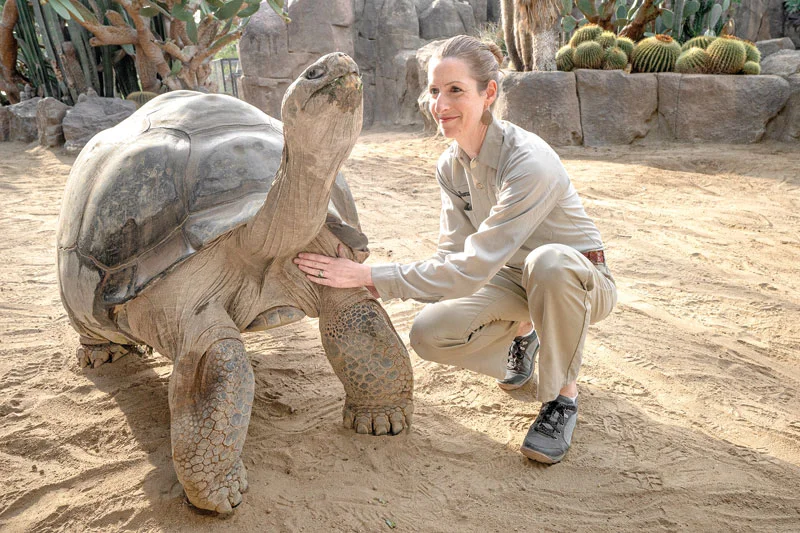
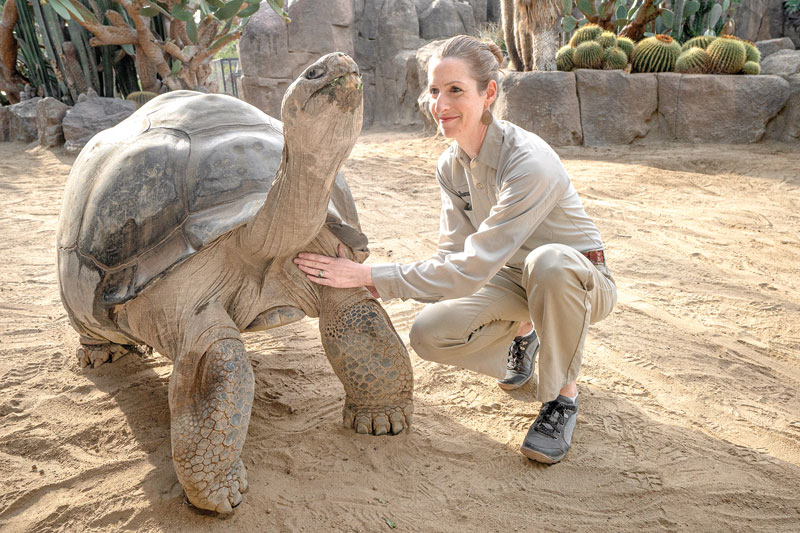
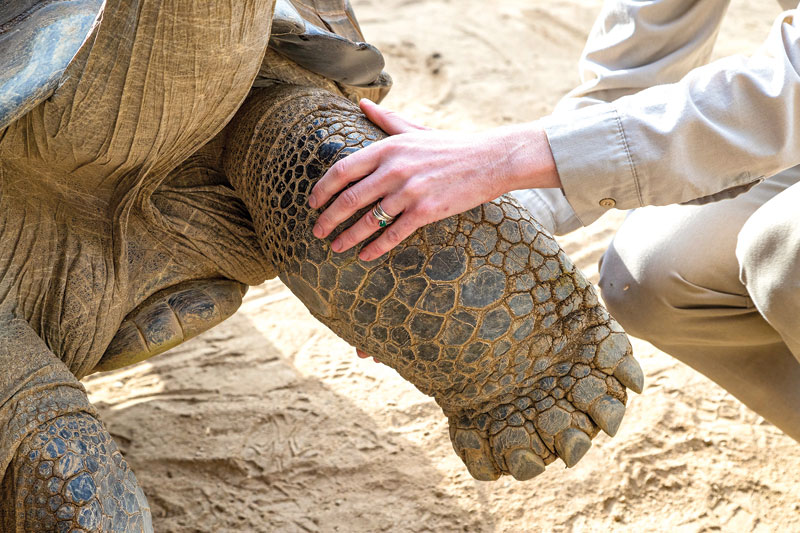
Zola, a female aardvark at the San Diego Zoo, suffered a neck injury when she was young. Her care includes therapeutic exercises twice a week, analgesics, acupuncture and manual therapy. Three geriatric Galapagos tortoises at the zoo receive weekly manual therapy for osteoarthritis. Brenner says therapists use the shell as they would the ribs and spine when moving the animals’ bodies through different planes, and massage their limbs.
At Brookfield, a female leopard tortoise named Kaya receives therapy several times a week for a spinal deformity that caused hind-leg weakness and made defecation difficult. Her program includes assisted core stabilization on a balance ball, an obstacle course that encourages her to lift her legs, and incline work to build strength. Each exercise addresses a functional challenge specific to Kaya.
A Komodo dragon case brought the work to a wider audience
Murphy, a male Komodo dragon at the Smithsonian’s National Zoo, had arthritis in his joints. Steeil worked with Matt Brunke, a veterinarian specializing in canine sports medicine and rehabilitation, on a plan that included Synovetin OA, a radioactive isotope developed for dogs and injected into Murphy’s joints to reduce swelling and inflammation.
The team tracked Murphy’s mobility, gait and joint flexion using an evaluation rubric. Brunke says the measurements showed improved comfort after treatment. As Murphy aged, however, his joint problems worsened despite rehabilitation, and he was euthanized in December 2024.
The case also drew attention through a two-and-a-half-minute National Zoo video, “How Do You Help a Komodo Dragon with Arthritis?” Within a month of its release, Brunke received four consult requests from people asking about Murphy’s treatment for their pets. Some also asked whether the approach could help their own knee pain; he directed them to other options.
Radioisotope injections are one part of a broader toolkit. Zoo rehabilitation can also involve epidural steroid injections, cold laser and shockwave therapy, as well as targeted exercises. The choice depends on the condition and the individual animal, with clinicians drawing on methods familiar from veterinary and human physical therapy.
What zoo cases can teach everyday practice
Zoos share rehabilitation findings through medical conferences, journal articles and public videos. Brenner sees these stories as a way to prompt pet owners and veterinarians to consider therapy sooner. She says small-animal rehabilitation options have expanded considerably over the past five years, and expects community veterinarians to hear more requests for it as a standard part of care.
The practical lesson is already visible in cases like Mani’s: rehabilitation works best when diagnosis, repeatable measures, tailored exercises and trusted caregivers come together. Zoo teams adapt familiar veterinary techniques to unusual patients, and those adaptations can sharpen how clinicians think about mobility and pain in animals across the veterinary world.
Don Vaughan is an award-winning writer who frequently writes about veterinary topics. His work has appeared in Writer's Digest, The Saturday Evening Post, Cure Magazine, and Encyclopedia Britannica.
Discussion
Sign in to join the discussion.